Tuesday, 18 March 2014

UNRAVELLING UPPARK: 2. Dish of the Day


On beginning our collaborative commission for Unravelling Uppark one of the first tasks was to research the period and to find out more about Emma Hart and Sir Harry Fetherstonhaugh.  Who was this young woman, why had Sir Harry brought her to Uppark and what was she doing dancing naked on the dining table?  The research process was helped by the fact that, between September and December 2013, I was fortunate to be offered a residency at Guildhall Library, which, as the Library of the City of London, holds collections on the history of London and its trades as well as the largest collection of food related books in the UK.  The significance of the latter to our project was to be crucial.  But it wasn't long before I became fascinated by Emma's early life and her connection with the Georgian sex trade.

 
Emma Hart as Circe, painted by George Romney circa 1782 when she was just seventeen, shortly after she'd given birth to a daughter by Sir Harry Fetherstonhaugh. (Tate Britain)

Emma Hart, as she came to be known, was baptised Amy Lyon in 1765 in the parish church of Ness, a mining village on the Wirral peninsula in the north-west of England.  The daughter of a colliery blacksmith, she might have been destined to a life of back breaking drudgery hauling coal to the surface in baskets or perhaps working as a low paid domestic servant.  There were few opportunities for uneducated lower-class women in the eighteenth century and, as there was no legal requirement to pay girls under sixteen, they were widely used as menial labourers - beginning their working lives at around twelve years old.  Even if they were paid, many female domestic servants earned only £5 a year at a time when the average yearly wage for a skilled male artisan was £50. 

Amy's father died in mysterious circumstances when she was two months old and she was brought up in the home of her maternal grandmother in North Wales where there were many mouths to feed on a low income.  When she was twelve Amy, like many poor migrants from the countryside, made her way alone to London seeking work. 

She was taken into domestic service by a Doctor Budd and his wife but after a few months was thrown out on the street, penniless and homeless.  This wasn't an unusual occurrence.  Young females were arriving in London every day by the wagon-load and the supply of domestic servants out-stripped demand.  If one girl didn't suit another could be easily be found.  The only recourse for destitute girls was prostitution.  In the Georgian period a fifth of London's female population, including children, worked in the burgeoning sex industry which, with an estimated annual turn over of £20 million (multiple billions in today's money),  was more profitable than brewing, the docks and construction combined.  London was the sex tourism capital of Europe. Covent Garden was the epicentre with over 30,000 sex workers openly plying their trade in the surrounding streets. Prostitution wasn't illegal and neither was sex with young children.  Demand for very young girls, especially virgins, was high as sex with a virgin was thought to cure venereal disease and punters would pay 50 guineas for defloration rights.


Plate 3 of William Hogarth's 'A Rake's Progress' which depicts a posture moll at the Rose Tavern in Covent Garden.  The young harlot in the foreground is removing her outer garments whilst the landlord brings in the highly polished pewter platter on which she will perform.

The sex trade wasn't an easy option despite the fact that girls were at least getting paid for what was otherwise often being taken for nothing.  For most girls it was a short life. The majority were dead after five years of disease, alcoholism or drug addiction, bodged abortion, childbirth, violent assault or even suicide.  It's believed that for Amy street-walking, the lowest form of prostitution, was a temporary solution to a short term problem.  Although she would never talk about this aspect of her early life, much of which is shrouded in myth, it's believed that Amy may have first worked in the taverns of Covent Garden where she would have been familiar with the work of 'posture molls' - tavern harlots who performed striptease and lewd postures on large pewter platters to arouse the punters.  It is known that she variously worked as an artist's model, a maid to the wardrobe mistress at Drury Lane theatre in Covent Garden, as a 'goddess of health' (read exotic dancer) in Dr John Graham's spurious Temple of Health at the Adelphi (also known as the Temple of Hymen) and that then, at the age of fourteen, she was taken in by one of the most infamous madams of the day.

Charlotte Hayes, aka Mrs Kelly, ran a string of high-class brothels in St James frequented by royalty and the aristocracy.  Dressed in silks and jewels, elaborately coiffed, powdered and perfumed, as one of Mrs Kelly's 'chickens' the beautiful Miss Lyon would have taken a new name, Emily, and been groomed as a high class courtesan.  As well as the more obvious talents she would have learned the arts of singing, dancing and polite conversation - all for the pleasure of men like Sir Harry Fetherstonhaugh whose name appears in one of Mrs Kelly's account books. 

 
Painting of Sir Harry by Pompeo Batoni,1776, in the red drawing room at Uppark

Sir Harry Fetherstonhaugh was born in 1754 the only child of Sir Matthew and Lady Sarah Fetherstonhaugh.  Aged only twenty he inherited Uppark and a vast fortune on the death of his father who had made his money from the coal trade and his stock in the East India Company.  Spoiled, rich, charming, fun loving - and, by all accounts, a bit dim - Sir Harry was no stranger to sexual scandal. He had been packed off on the Grand Tour after getting a village girl pregnant.  Then, whilst on a debauched spree in Naples with the Duke of Hamilton, he'd seduced a young gentlewoman whose family were paid off to the tune of £300 by the Duke's uncle Sir William Hamilton, the British envoy in Naples - who, ironically, later became Emma's husband. 


From the pages of 'Town and Country' magazine 1775 - the story of a young Marquis who 'date raped' Miss S after spiking her drink with a sleeping potion.  Having 'lost' her virtue and good reputation she is then forced to become his mistress. Stories such as this fuelled the popular perception of men as sexual predators. (courtesy of Guildhall Library)

Back in England Sir Harry spent a good part of his inheritance - £3,000 in just a few months - enjoying the pleasures of fashionable London society: attending court balls, drinking, gambling and frequenting high class brothels. He was a  regular of the gossip columns of such society magazines as 'Town and Country' and 'Bon Ton' which titillated their readers with salacious accounts of the sexual exploits of aristocratic men.  According to some sources Sir Harry earned the nickname Baron Harry Flagellum for his reputed sexual predilections.  (Posture molls often offered flagellation as a side line.)

At Uppark he gave lavish country house parties - the days spent hunting and shooting and the nights spent wildly carousing.  If the hunting ground was the place to win friends in high places and gain political influence (just as the golf course is today) then the dining room, an innovation of the eighteenth century reflecting a greater emphasis on the elegant serving of meals, was the place to ply those friends with fine food, drink and after dinner entertainment. 

Sir Harry employed a French chef, 'service a la Francais' being the height of fashion for the rich in Georgian times.  Nowadays we eat in the Russian style with savoury and sweet dishes succeeding each other in separate courses.  Then the French style dictated that all dishes were presented simultaneously, somewhat like a buffet, with sweet and savoury food laid on the table together.  Though by the mid-eighteenth century a separate dessert course, from the French desservir - to 'unserve', had become increasingly popular in smart circles.

 
A serving suggestion of small birds from  Charles Carter, City and Country Cook, 1736 - courtesy of Guildhall Library.  Couldn't resist this: shades of Monty Python with the young Rooks!
 
 
A dessert course of sweetmeats, hot-house fruits, jellies and syllabubs from Charles Carter (ibid).  Desserts using sugar imported from the West Indies - fruit of the slave trade - were expensive luxuries only the rich could afford.
 
For a large dinner party up to 50 dishes might be arranged in symmetrical patterns - the food decorated with fresh flowers and herbs.  Roasted meats, game, fish, waterfowl, seafood and small birds would be accompanied by vegetable dishes, pies, exotic fruits and sweetmeats (boiled sweets and candied fruits).  Guests would help themselves to as much as they liked of the dishes closest to them or pass portions to those seated nearby.  The food, often having come from the kitchens along long draughty passages, was served either cold or lukewarm.  It was considered déclassé to eat hot food as only the lower classes ate food straight from the fire. (One of Sir Harry's innovations at Uppark was to build the underground passages linking the kitchens with the servery and dining room that inspired H.G. Well's Time Machine - perhaps he preferred his dishes hot!)

We've perhaps become used to thinking of the Georgian era as a time of gluttony and overindulgence, especially by the upper classes.  But food on this scale was more about status and conspicuous consumption than it was about appetite. It was just showing off!  It was a time of great extremes.  The super rich of their day were a small minority and it's easy to forget that the vast majority were often on the verge of starvation. In just a few years the French Revolution would be reputedly sparked by Queen Marie Antoinette's callous comment, 'Let them eat cake'.

It was some time around 1780 that Sir Harry reputedly met Emily Lyon.  Some accounts say he first saw her dancing around the Celestial Bed (couples could pay 50 guineas to have sex in it as a cure for infertility or impotence) at Dr Graham's Temple of Health, others that he hired her for a year from Mrs Kelly - at considerable expense - and took her to Uppark to serve and entertain his male guests at dinner. 

Whatever the truth we began more than ever to wonder about the nature of their relationship and Emma's role as hostess at Uppark.  Was she herself the elegant and expensive dessert dish served up once the table had been cleared after dinner and did Sir Harry's guests devour her with their eyes only?


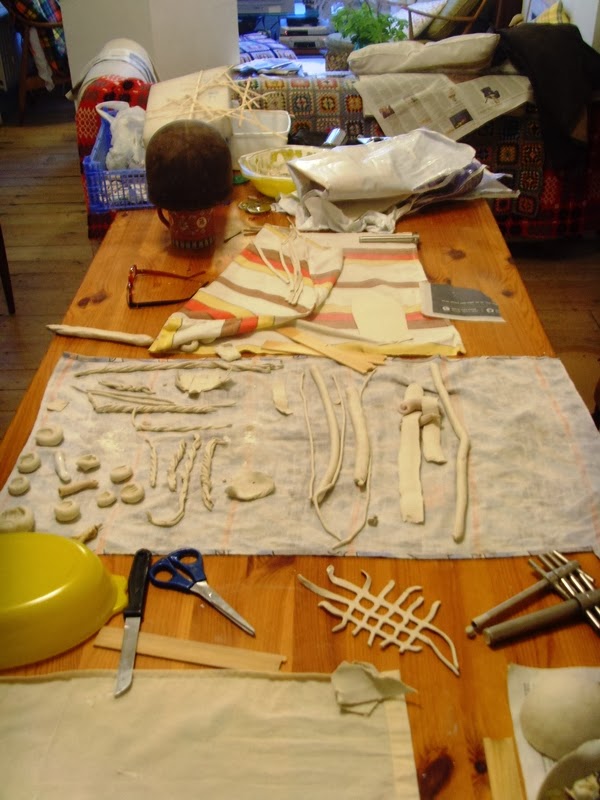
Getting into the spirit of making at home with our collection of vintage kitchenware and a bag of paper clay. Love the 1950s colour co-ordination! 

With all this in mind it was now time to clear our own dining table and assemble the ingredients for our dish of the day...


Friday, 28 February 2014

UNRAVELLING UPPARK: 1. A modest proposal


Uppark - West Sussex UK (National Trust images, Matthew Antrobus) 

Unravelling Uppark, the latest set of 10 contemporary commissions for the National Trust curated by Unravelled Arts and supported by Arts Council England, opens at Uppark in West Sussex from 4th May to 2nd November 2014.

Unravelled Arts www.unravelled.org.uk  commissions site responsive works and interventions from makers operating at the interface of craft and fine art and the pieces are installed in historic settings in order to draw out the multiple stories, characters and artefacts associated with the site.

I've worked on a collaborative commission for Uppark with my partner ceramist Robert Cooper www.robertcooper.net Titled 'Dish of the Day: Chicken in a Basket' our piece was inspired by three characters from Uppark's history; the writer H. G. Wells, best known for his science fiction novels, whose mother Sarah was housekeeper at Uppark in Victorian times, Sir Harry Fetherstonhaugh, owner of Uppark in its  Georgian heyday and Amy Lyon (later to become Emma, Lady Hamilton the lover of Lord Nelson) who spent a year there from the summer of 1780.

 
The red drawing room at Uppark
 
We first visited Uppark on a May afternoon last year.  The primroses were out in the spring sunshine on the banks by the car park but it was chilly inside the house and we had to move briskly through the rooms to keep warm.  If I'm honest I was also left somewhat cold by the fine array of furnishings, paintings, plasterwork and object d'art on display in the drawing rooms, parlours and bedrooms - testament to the wealth, patronage and taste of successive owners.  Uppark also bears witness to the dedication of Lady Meade-Fetherstonhaugh, an early pioneer of textile conservation and to the skills of conservators and craftspeople who helped restore much of the collection after a devastating fire in 1989.

 
Scullery

                                                            
                                                         The larder

 
the kitchen table

Looking back through the images I took then I was much more engaged by the downstairs world of the servants - all the bustle and repetitive drudgery of domestic labour now frozen in time and orderly array.

 
The housekeeper's room at Uppark


                                           Underground passage at Uppark

This was the below stairs world that H.G. Wells would have inhabited as a boy and the underground passages linking the kitchens with the upstairs servery and dining room are thought to have inspired the subterranean world of the Morlocks in his novel 'The Time Machine'.  It's one of my favourite science fiction stories - a first for having introduced a mechanism for time travel.  I think the novel captures some of the ambivalence towards both the upper and lower classes that Wells might have felt as the socialist son of Uppark's housekeeper and the rigid social stratification he might have observed there. Wells' vision of a future dystopian arcadia in which the human race has evolved into two distinct species descended from the upper and lower classes, one of which feeds on the other, can also be read as social critique in the grand tradition of Jonathan Swift. 

Swift's 1729 pamphlet 'A Modest Proposal' is a biting (no pun intended) satire of 18th century mercantilism - the prevailing economic system in which the rich merchant classes prospered at the expense of the poor whose wages were kept deliberately low to maximise profits and increase incentives to work.  Labour was a commodity and no child was deemed too young to work.  In many cases wages were non-existent, slavery for example, and the fact that there was no legal requirement to pay girls under 16 so they were often used as cheap domestic labour.  Swift proposes a macabre solution to the dual problem of over-population and famine in Ireland - selling the children of the poor as luxury food for the rich.  It caused outrage at the time because many simply didn't perceive the irony and thought he was being serious.  The double irony is that he sort of was!  The poor were dying in their millions of starvation whilst the rich lived life on the hog in an orgy of conspicuous consumption and the pursuit of pleasure - the legacy of which we can still see today in houses such as Uppark. 

 
Ceramist Robert Cooper (centre back) in the dining room at Uppark
 
One of the stories we heard on our visit was that in 1780 fifteen year old Emma Hart had reputedly danced naked on Uppark's dining table to entertain Sir Harry Fetherstonhaugh's  male guests. It was this story, which chimed so discordantly with our modern knowledge of child sexual exploitation, coupled with the cannibalistic imagery of H.G. Wells' 'Time Machine', in which his time traveller refers to the childlike Eloi as 'delicious people', that stuck in our minds as we went home to work up our own 'modest' proposal. 
 
 
    Mid 18th century Sceaux faience dish - tin glazed earthenware
with hand painted floral decoration
 
What we submitted was a proposal to combine our craft disciplines of ceramics and basketry (the upstairs/downstairs of the craft world?) to weave a large ceramic basketry dish, reminiscent of an 18th century Sceaux faience basket in the Little Parlour at Uppark, which would re-contextualise the relationship between Sir Harry and Emma Hart. 
 
We titled it 'Dish of the Day: chicken in a basket' - playing on the multiple connotations of the word dish; shallow serving vessel, a serving of food, an attractive person, scandalous gossip and, in modern US slang, destroyed reputation.  'Chicken in a basket' not only got in an actual reference to basketry - but also to pretentious fast food and sleazy under-age sexual entertainment.  We knew very little about Sir Harry or Emma Hart at this point but felt instinctively that our dish would somehow interweave their story with modern day slavery and the world-wide trafficking and commercial sexual exploitation of women and children. 
 
                                      
                         Making a start on 'Dish of the Day' on our dining table
 
The collaboration would also be a challenge for both of us. We'd never worked together before and our ways of working are very different. Though we each have our own studio neither of us wanted to work in the other's space so we decided to work on the dining table in our living room at home.  A recipe for domestic conflict in the making? Time would tell ...  

Monday, 4 November 2013

A MEASURE OF CHAOS


A MEASURE OF CHAOS: my new solo show at the Pound Arts Centre, Corsham in the heart of rural Wiltshire.  It was a privilege to be asked to exhibit for the annual Corsham Festival and I want to say a big THANK YOU to everyone who helped with the show - I thought it looked fantastic.


It was such a lovely surprise to walk into the exhibition and see how Celia the gallery technician and Martin the centre manager had displayed the work in the listed Victorian school house which is now the Pound Arts Centre. 
 
My 'happy snaps', taken just before my 'meet the artist' event on Saturday evening, don't really do the show justice. So, for those who couldn't make it to Corsham, here are a few shots of the work in situ - augmented where possible with studio images and close up details.
 
 
Stella Harding, A MEASURE OF CHAOS, 2013 - plaited vintage steel tape measure and telephone wire - both 'redundant' materials.
 
The theme, A MEASURE OF CHAOS, came partly from my love of weaving with vintage steel tape measures, many of them made in my home town of Sheffield, South Yorkshire - once world famous for its steel industry and precision calibration tools. Generations of my family worked in the factories before they were closed down.  Others had worked in the nearby pits - supplying coal to fire the furnaces. Both my great grandfather and my great-great grandfather were colliery blacksmiths. In the 1980s whole communities fell victim to political forces that measured everything solely in terms of  profit. 
 
The theme also refers to the fact that many traditional baskets were in themselves official measures.  A bushel, a half bushel, a peck, a cran and a sieve, for example, were precise measures of different produce.  Their production, by highly skilled basket makers who would have served a long apprenticeship, was controlled by Customs and Excise officers checking that the baskets measured up to the standard.  In several instances I've inverted this tradition by using 'measures' to make contemporary basketry.
 
In addition, many of my weaving techniques explore the intricacies of three dimensional geometry -   the term geometry itself  meaning earth measure. 
 
But in the modern world, in the words of Leonard Cohen, 'There ain't nothing we can't measure any more'. Even chaos! 


Stella Harding BLOOMING (left) and A MEASURE OF THE STARS (right)
 
 
Stella Harding A MEASURE OF THE STARS 2013 - plaited vintage steel tape measure, spun paper tape and telephone wire.
 
In addition to a vintage steel tape measure made in Sheffield by Rabone-Chesterman circa 1950 this piece uses painted spun paper tape, another redundant product, that was made in West Yorkshire on the same machines that were used to spin wool before the decline of the woollen industry.  The tape was originally used as strapping on the machines and later to bind packages before it too was replaced by polypropylene strapping tape.  I'm now eking out the last few metres of my dwindling supply. 
 
 
                    Stella Harding BIG BANGLE 2013 - plaited etched steel tape measure circa 1920
 
 
Stella Harding BIG BANGLE - work in progress - using approximately 25 feet of  etched mild steel exquisitely patinated with age and wear.
 
A local gallery owner who came to the show asked if  I would consider lowering the price of these tape measure pieces.  I politely declined. I may look like a soft touch but my heart is pure steel when it comes to respect for my 'redundant' materials and the craft processes that underpin my practice.  (Wannabe gallerists take note: a small measure of respect wouldn't go amiss sometimes.)


Stella Harding NEW BLOOM 2013 painted willow, jute and rattan
 
 
Stella Harding NEW BLOOM 2013 (detail)
 
Not all the work in the exhibition uses measures though. This 2 metre high wall piece is part of my on going exploration of a hyperbolic-paraboloid form I came across by chance manipulation of a twining technique.  For me it resonates with the control and release of energy (as in exploding super-novae for example) and the chaotic, contrasting, kinetic effect of intersecting hard lines and soft shadows. 
 
Some people see Native American feathered head dresses, Zulu spears, Zoroastrian sun rays or broken bird wings.  There's a measure of chaos in all creativity, I think, and in the range of meanings it evokes - long may Chaos reign.
 
 
Stella Harding  ARCHEFOSSILS, JEWELS and HAGSTONES
 
I liked the way the Pound  displayed these spiral plait pieces in deep boxed cubes.  Each cube  becomes a little installation of these ambiguous forms - part engineered/part organic - as they take centre stage - singly or in pairs - in a frozen moment of time and space.    


Stella Harding KEPLER'S JEWEL - photo Trevor Springett
 
 
Stella Harding SHOW YOUR WORKING OUT - photo Trevor Springett
 
Kepler's Jewel and Show Your Working Out both reference the three-dimensional geometry underlying many basketry techniques and forms and my own attempts to negotiate the fine line between order and chaos to find a balance between mathematical precision and gestural spontaneity.  The grey 'ball' of fine rattan on the bottom left formed itself  when I plunged several very orderly and tight sprung coils into a pan of hot dye.  They ravelled themselves together in a trice - hours of pans-taking work undone before my eyes; a happy accident so perfectly imperfect that it's probably unrepeatable.


Stella Harding CHINA BLUES - painted lime wood and rattan. Photo Trevor Springett 
 
I also allow the long fine painted stems to arrange themselves as I weave around them.  It seems I need an element of unpredictability or surprise in my working process.  The more I make though the harder this is to achieve - one's hands and eyes become too knowing as the level of tactic knowledge increases with repetition.  When there is no further measure of chaos to take me by surprise I know it's time to move on;  the wonder is gone and only tried and tested formulae remain.
 

Monday, 2 September 2013

CONTEMPORARY BASKETRY at MORLEY COLLEGE


I'm thrilled to have been appointed as basketry tutor at Morley College, London where I'll be teaching an evening class CONTEMPORARY BASKETRY for BEGINNERS and IMPROVERS

The class will run for three 10 week terms per year on Tuesdays from 6-9pm and the start date for the first term is Tuesday 10th September.  There are still places available if you'd like to join us.  No previous experience necessary and tools and materials are provided.

Week by week you'll be introduced to all the major basketry techniques including coiling, looping, twining, stake and strand, plaiting, interlacing and assembly as well as a wide range of exciting materials.  We'll explore form, texture and surface decoration and there'll be plenty of opportunity to work on your own projects including making functional containers, sculptural forms, jewellery or fashion accessories.

See http://www.morleycollege.ac.uk/courses/art_design/938-contemporary_basketry_for_beginners
for more course details or contact enquiries@morleycollege.ac.uk quoting the course code VTX027A

Here's a small taster of some of the techniques we'll be exploring.

 
Open hexagonal plaiting with bias plait sides and windmill plait border
 
 
Cobbling (random coiling)
 
 
Looping
 
 
Check weave plaiting
 
 
3D Looping
 
 
Covered core coiling
 
 
Spiral plaiting
 
 
Interlacing (random weaving)
 
 
Pinwheel plaited base
 
 
Stake and strand - waling and twining
 
We'll be working in the newly refurbished textile studio at Morley and there'll be opportunities to exhibit work in Morley's own Gallery as well as the textile department's showcases.
 
If you want to learn exciting new skills, enhance your creative practice or relax into the weave in a friendly and supportive environment come and join us.


Thursday, 13 June 2013

Crafting the Genome Lab: MRC open day


Scientists all around the UK are celebrating the centenary of the Medical Research Council this year and the geneticists, structural biologists and crystallographers at the Genome Damage and Stability Centre, University of Sussex, are no exception.  They've planned a whole day of discussions, demonstrations and lab tours to promote their ground-breaking research.  A particular specialism is  damage caused to our DNA and what the body's attempts to repair it can tell us about cancer and rare genetic disorders.


Back in 2012 they hatched a plan to invite artists with an interest in science to contribute to the day and I was one of the ones who responded.  Land artist Chris Drury, who has made several works inspired by genetics, will show one of his large-scale pieces and Shirley Chubb will install Darwin's 'Thinking Path'. 

 
Stella Harding BLUE JEWEL 2011, Photo Ester Segerra
 
People have often suggested that my spiral plaited forms look a bit like the DNA double helix, but rather than show an existing piece I proposed something a little different to the organising committee.
They wanted the day to provide an opportunity to communicate with members of the public, an opportunity for dialogue and active engagement.  My suggestion was that on the day scientists, artists and members of the public should work together on making an interactive installation crafted from the very 'stuff' of the genome labs.  At the initial meeting I wasn't sure exactly what this stuff might be - I had some vague idea it might involve waste paper - lab reports, research papers, old journals and the like.  This was before I'd actually visited any of the labs in the centre. 


Plastic! fantastic!! Far from the sterile, orderly white-coated stereotype here was a myriad of colourful chaos.  And, after one use, most of it goes in the recycling bins! 


                Of course, it's all colour coded and sorted into hazardous and non-hazardous waste.

 
All handled with equally colourful gloved hands.  This is the everyday stuff of lab craft.  So, if  DNA is 'the stuff of us' - the building blocks of life,  then all this plastic paraphernalia from the research laboratories would be the building blocks for Crafting the Genome Lab - a fantastical experiment in collaborative making and repairing and having fun! - which is what a celebration should be about.
 
I've certainly been having fun playing with some of the tip-box covers and six-well dishes in the studio - their perforated, cellular grid forms remind me of Lego and Meccano building blocks.


So, somewhat predictably, I couldn't resist making my own tip-box high rise.


Eat your heart out Norman Foster.
 
Who knows exactly what we'll make on the day.  There's a large space in the entrance of the Fulton Building to fill and to get things going I'll be contributing a 2 metre length of my plaited 'DNA' (each 2 metre double  strand of tightly packed DNA is unravelled and copied every time a cell divides).  Participants will be invited to 'damage' and repair it in whatever way they see fit.  There'll be plenty of scientists and PhD students on hand to help out and answer questions.  After talking with crystallographer Tony Oliver I've a hankering to grow a large glittering crystalline structure out of hundreds of 5mm pipettes - but I've heard the students are a dab hand at making elephants out of plastic gloves so it's all to play for on the day............
 
If you'd like to learn more about DNA damage and repair, have a look through an electron microscope or if you just want to get your hands on some plastic see www.mrc-genome-openday.com for details.