
The Private View for 'Maggs Beneath the Covers' held at Maggs Antiquarian Bookshop 50 Berkeley Square, Mayfair to coincide with the Lapada Art and Antiques Fair was definitely an upper crust affair - even down to the hand-raised, traditional crusty meat pies with lashings of English mustard served alongside the champagne. There was cake too - quite a spread. These days it's rare to see so much as a peanut at the average private view. Curator Penny Green had done us proud and not just with the finger food.

Works by the twelve artists who'd been commissioned to respond in 'extreme and conceptual ways' to Maggs' collections of rare books and manuscripts are beautifully displayed over all four floors of the Georgian town house close to the books that inspired them. Some are in hallways and others in the garden - including 'books of remembrance' by ceramist Robert Cooper .

Penny Green's own work installed on the first floor landing - two seated figures representing the poets Elizabeth Barrett and Robert Browning - looks as if it had been there forever. Look carefully and you can just spot Robert Browning sitting in the sunlight by an orange tree.
In curating the exhibition Penny had decided not to have any labels or statements close to any of the work. A small brochure guides visitors to the general location of each piece and they are left to discover them, or not! depending on their powers of observation. Some of the interventions are so subtle as to be easily missed. But that's the fun of this kind of exhibition - it invites curiosity, exploration and active engagement with the site.

Some of those who came got so into the spirit of discovery that they were found wandering 'off piste' in the dusky underground storerooms and passage-ways trying to decide whether the various piles and accumulations were art-works or just dead stock. Brave of them I thought, as darkness was falling and the place is notoriously haunted by a broken-hearted 'Mr Havisham' - cruelly jilted on his wedding day.
My piece 'Between the Lines' is sited on the second floor in the Continental and Illuminations Department close to where I'd been standing when I'd first glimpsed 'my' book in Paul Quarrie's hand on the site visit. I was expecting a special visitor to the private view, Cat Lucas, English Pen's Writers at Risk campaigns manager, and had arranged to meet her there. Cat had asked me to write a guest post for their website and in yet another example of happenstance the posting and the exhibition opening co-incided with the release of Salman Rushdie's latest book 'Joseph Anton'. Censorship, free speech and freedom of artistic expression were hot topics.

Between the Lines by Stella Harding
Although ultimately the work will have to speak for itself and tell its own story, being there in the room alongside it gave me an opportunity to find out what it has to say to others and to answer questions about it. A member of Magg's staff had seen the piece prior to the private view, and, knowing little about it, told me it reminded her of a brazier - in which banned books might have been burned. In the sixteenth century when Francesco Ghesi, the book's owner, was writing his defence to charges of heresy it was more than books that were being burned - convicted heretics could face death at the stake. In recent years we've seen the burning of books and effigies of writers by religious fundamentalists and only a few weeks ago on July 30th, Dang Thi Kim Lieng, the mother of imprisoned Vietnamese blogger Tai Phong Tan, died in a defiant act of self immolation. She was protesting the detention of her daughter - a former policewoman who'd built up followers around the world with her blogs about police abuses in Vietnam.

Most people wanted to see the book that had inspired my piece. Impossible in this case as it had been sold before I'd had the chance to really see it myself. But imagination is a wondrous thing and as I explained that the small area of 24 carat gold leaf represents the 'footprint' of the book - people began to make connections with other imprints, shadows and memories of lost objects from their own experience.
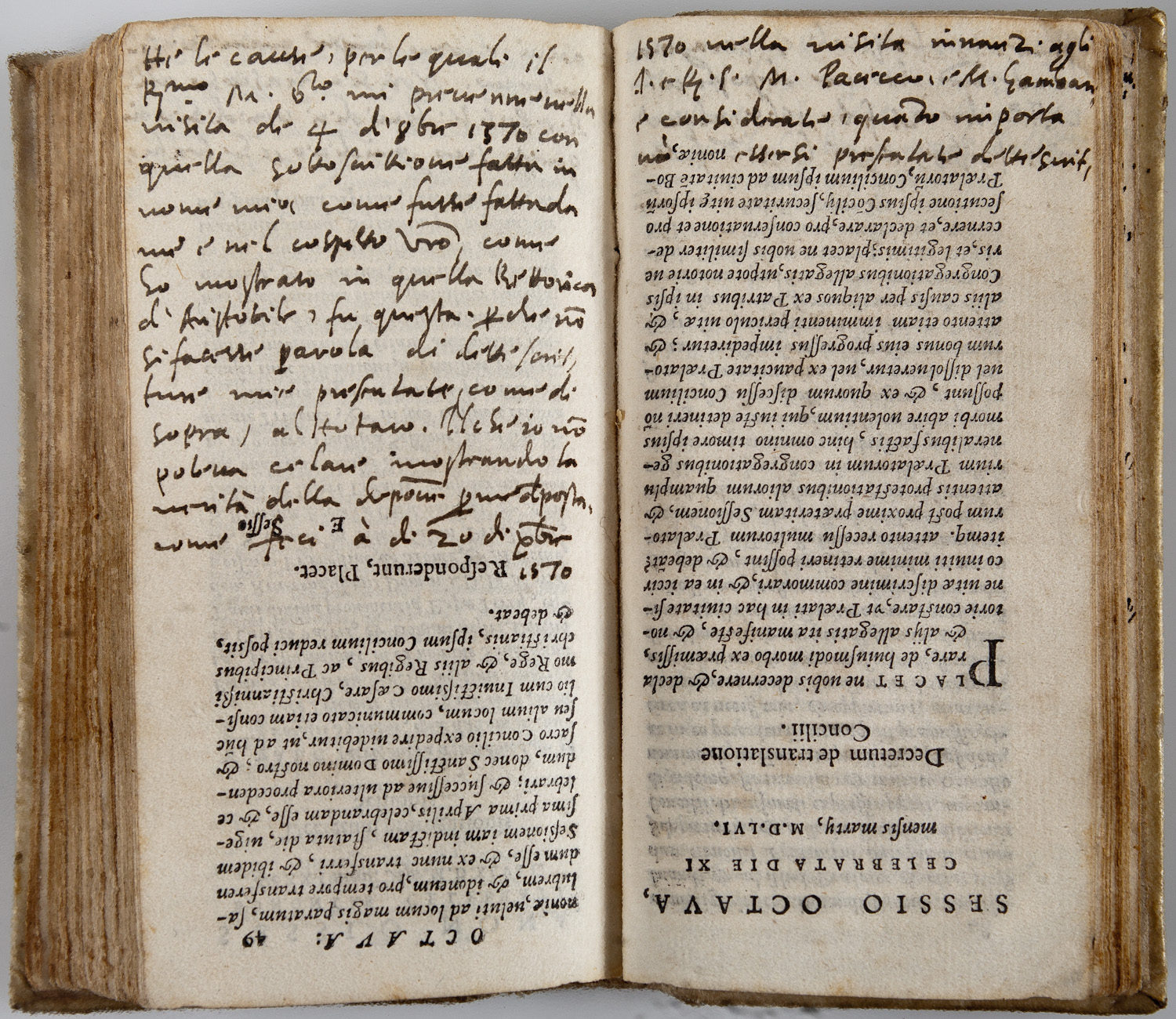
When Cat Lucas arrived we were able to connect the small size of the book to the size of Francesco Ghesi's handwriting as he'd written in the spaces between the printed text. Many prisoners of conscience write under extreme conditions - some write in infinitesimally small script on tiny scraps of paper or rag which can be smuggled out by friends or sympathetic guards. Handwriting can say so much about a person too and small changes over time often alert human rights observers monitoring a prisoner to changes in their circumstances.
I'd enjoyed handwriting a letter to Busra Ersanli, something I haven't done for years, and had been touched to receive her letter in return - hand written after her release pending retrial. In a sense this project has been as much about the history of human communication as about one book. The laborious work of stamping individual letters onto the lead strips was juxtaposed by the immediacy of tweeting an update to this blog - telescoping the centuries from Roman times to 21st century social media. My internet searches, emails to English Pen, blog posts and various digital interconnections are as much a part of the creative process of this project as the final woven lead container. What connects us as humans isn't the means by which we communicate but the desire to do so. The desire for freedom of speech and artistic expression will find a way.

I'm writing this post now as Busra Ersanli and nearly two hundred others face another trial in Turkey tomorrow October 1st. In her letter to me Busra wrote of her friend, the translator and women's rights activist Ayse Berktay and whether anything could be done to bring her to attention. Ayse's name is one of several imprinted on the lead - a small gesture of solidarity.
Monday October 1st also sees the hearing in Russia of an appeal by the three members of Pussy Riot, Nadezhada Tolokononikova, Maria Alyokhina and Ekaterina Samutsevich, imprisoned for two years after their peaceful performance protest against Vladimir Putin and leaders of the Orthodox Church who support his repressive measures. Artist David Shrigley has added his support by designing a T-shirt for Amnesty International and English Pen are holding a Poems for Pussy Riot poetry protest at 11.00am on Monday October 1st at the Champion pub Wellington Terrace, London W2 4LW. www.englishpen.org/poems-for-pussy-riot-ebook They are asking those who can't attend to write about the event and the ebook of poems on their websites, blogs and Twitter.

Even the smallest gesture can make a difference to a prisoner of conscience. Sending a book, a letter or postcard of solidarity lets them and their captors know that they are not lost to the eyes of the world. A quick tweet or an email to a government or regime acting in contravention of human rights costs nothing, takes only a few moments and is surprisingly simple to do with modern communications technology. See English Pen's Rapid Action Network for how to do it. www.englishpen.org
If you get the chance please do visit 'Maggs Beneath the Covers'. Don't be put off by the imposing location and the entry buzzer. You'll find a warm welcome inside 50 Berkeley Square and the freedom to explore and discover for yourself all the inspiration you could desire.
'Maggs Beneath the Covers' is on until 21st December 2012. 9.30- 5.00pm Monday-Friday, closed Saturday and Sunday. Please see www.maggs.com for more information.


