Thursday, 16 May 2013

LINE OF BEAUTY


"Beauty is the First Test", curated by Liz Cooper, 27 April - 30 June 2013, National Centre for Craft and Design, Sleaford

When I heard last year that this exhibition was opening at the Pump House Gallery in London I felt a twinge of regret that I wasn't part of what was one of my 'wish-list' exhibitions.  So I felt very privileged to have been asked to participate as a case study as it travels to various new venues around Britain.  I've been banging on about the mathematics underlying basketry techniques for years not to mention my own past experiences with the subject.


Spot the pattern - six around one never fails to delight and Lesley Halliwell's spirograph drawings are one of the highlights of the show


Views of the exhibition at the National Centre for Craft and Design, Sleaford.  Showing work (on the walls) by Lesley Halliwell, Janette Matthews, Michael Brennand-Wood, Janice Gunner and Ann Sutton and (on the floor plinth ) textiles by Lucy McMullen.  Four of the five case studies can be seen  displayed on specially commissioned furniture by David Gates.  Photos: Liz Cooper

The brain-child of curator Liz Cooper, herself a former school maths champ, this exhibition brings together artists and makers whose work (mostly in textiles) "explores how mathematical concepts underpin craft techniques and artistic development".  The title is a quote from British mathematician G. H. Hardy - one of the first to propose mathematics as a language for describing patterns:

"...the mathematicians patterns, like the artist's or the poet's must be beautiful; the ideas, like the colours or the words must fit together in a harmonious way.  Beauty is the first test: there is no permanent place in the world for ugly mathematics" (Hardy, London: 1941).

'Beauty' may have lost its currency as a standard for judging works of art since Hardy's day, being now considered too subjective or socially constructed a concept.  And there are many 'ugly' patterns of human psycho-social, political and economic behaviour that claim the attention of contemporary artists.  But as Liz Cooper herself points out in the Pump House Gallery exhibition booklet, the word sets up a challenge and a subject for debate - especially when applied to craft practices.

"In craft it is debateable whether one wants beauty as an end result - especially if one eschews the bucolic vision of William Morris and an idealised ruralisation of craft practice that conveniently ignores the location of most art schools and colleges, and the majority of the population, in cities and towns." (Cooper, London 2012)

 
Contemporary bobbin-lace making by Gail Baxter and Carol Quarani - two of the five case studies - with sculpture and drawings by Peter Randall-Page (centre) and Ann Sutton in the background. Photo: Liz Cooper

The inclusion of the five craft 'case studies', including lace-makers Gail Baxter and Carol Quarani, furniture maker David Gates, basketry by Stella Harding and woven textiles by Margot Selby, not only adds focus on process and materiality but also challenges perceptions of contemporary craft practice. 


Contemporary basketry case study by Stella Harding with sculpture by Suresh Dutt in the background.  Photo: Liz Cooper

My own case study, showing three-dimensional geometric forms in a plaiting technique more often used to make straw 'corn dollies' and a wearable structure plaited from a redundant steel tape measure - disrupts preconceptions about the materials, techniques, forms and functions associated with basketry.

 
A book, with text by Liz Cooper, giving insights into each case study maker's studio practice, materials, inspirations and artistic development is displayed alongside the work.  In some cases the makers have also provided sketch-books, tools, models or work-in-progress.


David Gates' case study showing scale models of his bespoke furniture, a range of carpentry joints and a developmental sketchbook is exquisitely engaging.  Photo: Stella Harding

 
 Carol Quarani's case study illustrates how she uses lace as a medium for conceptual work.  Her doctoral research explores how lace curtains can be used to re-read the relationship between the domestic, the uncanny and the Gothic 
 
 
Contemporary bobbin lace by Carol Quarani
 
Pattern  recognition may be a basic human attribute and one of the ways in which we make sense of and come to understand the world.  Order, symmetry, balance, harmony and repetition can be safe and comforting. Often though we only recognise the significance of a pattern when it is disrupted in some way - by small irregularities, asymmetries, discord, accidental marks leading to unintended consequences.  This for me, is the beauty of  this exhibition.  If we look closely it reminds us that chaos is part of the equation - that the devil is in the detail and that beauty is only ever skin deep. 


Oh, and I loved the way the shadows of the case studies on the gallery floor grounded the structures, animated the space and created a dramatic film noir effect.


Which allows me to segue shamelessly into a plug for a forthcoming experimental film of the case-studies, commissioned by Liz Cooper from film makers Electric Egg and funded by Arts Council England.  The film will be shown alongside the exhibition from the end of May.

But I'm going to leave the last word to G.H. Hardy - ever the one for a pithy quote:

"It is a melancholy experience for a mathematician to find himself (sic) writing about mathematics.  The function of a mathematician is to do something (...) and not to talk about what he or other mathematicians have done. (...) There is no scorn more profound, or on the whole more justifiable, than that of the men who make for the men who explain." (London: 1941)

Better get making then!!

Wednesday, 13 March 2013

MATHS ON MONDAY


                                          Stella Harding JEWELS -  photo: Arnold Borgerth

When I started secondary school we were given two books - a copy of the King James Bible and a book of Logarithmic Tables.  We were told we could keep the bible when we left school but the Log Book - the mathematicians 'bible' - would have to be returned.  I covered both in brown paper to keep them clean and stowed them in my desk for the duration.

Despite being a confirmed atheist I loved Scripture (as Religious Education was called at our school).  My teacher was a scholar of ancient Greek and Aramaic who had worked on the Dead Sea Scrolls.  She was also a liberal thinker with a wicked sense of humour who opened our minds to all manner of 'heresies'.  I excelled at the subject.

Mathematics was another story. I had the same teacher for six years and she made my life a misery.  She was one of those draconian maths teachers, thankfully fewer in number these days, who should probably be held to account for the poor levels of adult numeracy in this country.  She was a bully who derived pleasure from humiliating those less able than herself.  The prospect of double maths on Monday mornings made me sick to the stomach.  On the few occasions when I was called upon to consult my Log Tables the columns of numbers would swim before my eyes like indecipherable cuneiform.  She was also a tyrannical control freak who demanded absolute submission to her rule - and woe betide if you ever forgot your ruler!  The idea of educating enquiring minds was an antithetical heresy.  I failed O-level maths twice before deciding enough was enough and I handed back my Log Tables.  Whereupon Miss T flew into an apoplectic rage and ordered me (then aged 17) to stand in the corner of the room - the classic punishment in Victorian times for the class dunce - thought this was the late 1960s!  I politely refused, found another teacher and passed my O-level maths on the next re-take.

 
    The other side of the equation: Stella Harding PRECIOUS JEWEL 2010 m2 gallery, London

I confronted many of these demons in 'Show Your Working Out' my solo show at the m2 gallery in 2010.  Though something of a cliche this phrase, beloved of maths teachers and uttered with varying degrees of exasperation, makes obvious connections with showing aspects of both the material process and the hands-on thinking through making of contemporary craft.  Though we're often only privy to the final resolution the mis-calculations, crossings out and scribbles in the margins can be equally revealing to an onlooker. 

I was particularly inspired at the time by the writings of the 17th century astronomer and mathematician Johannes Kepler who wrote of geometry as having "... two great treasures; one is the theorem of Pythagoras; the other the division of a line into extreme and mean ratio. The first we may compare to a measure of gold, the second we may name a precious jewel."  He was referring to geometry but it was the poetry of his language that struck a chord in me. 

 
                     My 'measures of gold', plaited vintage steel tape-measure bangles. 
 
Made in my home town, the steel city of Sheffield, by Rabone Chesterman - a company that specialised in high calibration tools and equipment - these tape measures with their exquisitely etched and printed numerals offered for me  a way of literally and metaphorically weaving mathematics and three-dimensional geometry using an intriguing plaiting technique. 
 
 
As the numbers weave over and under from left to right in a continuous line of progression, following the law of unintended consequences sometimes unforeseen disruptive patterns emerge.
 
I've just discovered that Kepler also wrote an essay in 1611 'On the Six Cornered Snowflake' which he gave as a Christmas present to his employer the Emperor Rudolf II - "since it comes down from heaven and looks like a star".
 
 
    BLING !!! (my guiding star) Stella Harding 2010, hexagonal plaited steel tape measures, dyed chair cane and spun paper. Photo: Trevor Springett


Stella Harding BLACK PEARL 2010, steel tape measure, polypropylene strapping tape and spun paper. Photo: Trevor Spingett
 
I appreciate Kepler's fascination for pentagons too - plaited in my case.
 
 
Stella Harding 2008, painted spun paper
 
Open hexagonal plaiting is another technique I come back to again and again - exploring it in different materials. 
 
 
Stella Harding (with Shane Waltener) 2011, stitched plastic bags, for Practical Basketry Techniques A&C Black 2012
 
 
Stella Harding 2012 'Between the Lines', stamped lead, for Maggs Beneath the Covers
 
 
So, fast forward now to this Monday when I had the pleasure of welcoming curator Liz Cooper to my studio.  Liz is the curator of  'Beauty is the First Test' an exhibition exploring the relationship between contemporary craft and mathematics which opened at the Pumphouse Gallery in London last year and is now travelling to venues around Britain and Ireland.  I first heard of this exhibition when working with Martin Shaw of the Crafts Council's Participation and Learning team to adapt one of the projects from Practical Basketry Techniques as an on-line tutorial for Key Stage Two maths students.  I'd suggested this project for Craft Club as I've long been aware of the natural mathematics underpinning many basketry techniques and the belief of some ethno-mathematicians that basketry was fundamental to the development of our human capacity for pattern recognition and manipulation of line and form in space. 

 
      Twining with 5-9 year-olds at Pitzhanger Manor in 2011 - one of my favourite  projects from 'Practical Basketry Techniques'.

When you think of maths as the science of pattern it's not so scary and even a five year old can being to get to grips with it. 

My contemporary basketry will feature as one of five case-studies (including weaver Margo Selby, furniture-maker David Gates and lace makers Carol Quarini and Gail Baxter) when 'Beauty is the First Test' opens again on 27th April at the National Centre for Craft and Design in Sleaford.  I can give a sneak preview of the piece that Liz Cooper chose to represent the mathematical concepts underlying many of my pieces.


      ARCHEFOSSIL 2012 - one of the latest in my line of spiral plaited 'Jewels'.  Photo: Arnold Borgerth.

Amongst other things this tightly interlocking three-dimensional spiralling form represents, for me, the ability of the human hand to grasp tacit knowledge that the mind might otherwise let slip.  And, since I've discovered, through basketry that I have 'mathematical fingers',  I'll be letting go of my previous maths phobia.

Saturday, 16 February 2013

HAPPY BIRTHDAY BOOK


HAPPY BIRTHDAY BOOK! 'Practical Basketry Techniques' is one year old today.  A lovely gift for anyone who wants to explore the creativity of three-dimensional weaving. 

Thursday, 10 January 2013

TRAVELLING LINES


Today sees the opening of AMULETS by Basketry Plus at Wardown Park Museum in Luton.  If you missed this collection on its first outing at the Petrie Museum of Egyptian Archaeology in London here's a second chance.

See www.lutonculture.com/wardown-park-museum for more details.

Look out for more work by Basketry Plus later this year at the Pitt Rivers Museum in Oxford.

Tuesday, 27 November 2012

We need to talk about basketry: #1 starting line


Life.  You wait ages for a storyline and then three come at once!  They're all interconnected and in one way or another touch on some of my recent thinking about basketry.

Are you sitting comfortably?  Then I'll begin.
(I haven't any particular images to illustrate this blog so I'm just going to insert a few random pics of my favourite basketry techniques)

 
Cordage by Pip Weaser of the Scottish Basketmakers Circle www.scottishbasketmakerscircle.org

I went to the Craft Study Centre (www.csc.acreative.ac.uk) in Farnham last week for a practical workshop on writing about craft run by centre director Professor Simon Olding and independent writer/curator Sara Roberts.  We were a small group - a mix of makers from different craft disciplines including textiles, ceramics and basketry alongside a couple of curators and educators.

After the usual introductions we got our brains into gear with an ice-breaker exercise in which Simon and Sara gave us each a minute to write down three words we felt characterised good writing about craft.  There were no right or wrong answers but what was interesting was that of all our combined words none were repeated. Several though clustered around the themes of clarity, simplicity and accessibility whilst others expressed a wish for writing about craft that is surprising, provoking and questioning.  We then mirrored the exercise with only thirty seconds to write down one word that sums up bad writing about craft.  Impenetrable, obfuscating, inaccessible and confusing were some that give a flavour of the general consensus.

 
Interlacing by Rachel Max www.basketryplus.org

Next was a talk by Simon and Sara on their top tips for good writing - well illustrated with engaging and inspiring examples, including one of my favourites; ceramist Matt Smith's piece for the catalogue of 'Unravelling the Manor'. www.unravelled.org.uk    www.mattjsmith.com   Then it was time for tea and a spot of networking before the challenge of crafting a few words of our own.

The brief was to select one object from the current exhibitions at the Study Centre and write fifty words about it for a general audience (reading age 12-14). With a checklist of points to include such as revealing something of the making process, providing a context for the reader to appreciate the work and including a human element - i.e. telling a story - we were given just ten minutes before having to read it aloud to the group! No pressure!!

Having decided there was no time to follow most of the others up-stairs to the exhibition of contemporary ceramics by Alison Britton I headed straight for the ground floor display of objects reflecting the life and work of Robin Tanner - print-maker, educator, craft collector and founding trustee of the Craft Study Centre.  I'd seen this fascinating exhibition, curated by Jean Vacher, on a previous visit so had an idea of what to expect, ceramics by Lucie Rie, Hans Coper and Bernard Leach, furniture by Gordon Russell, textiles by Barron and Larcher as well as etchings and engravings by Tanner himself.


                                         Samples of basketry techniques by Stella Harding

I was desperately looking for something that would connect to basketry in some way and the closest thing was exhibit No. 42 a rush-seated chair by Gordon Russell.  I've never done chair-seating but I know a lot of basket makers who have - it employs related materials and techniques.  Nine minutes left.  I began writing - accompanied by Vaughn Williams' 'Variations on a Theme by Thomas Tallis' playing softly in the background.  Some frantic word-counting and crossings-out later Sara came in to say 'stop writing'.  We then headed upstairs to face the moments of truth - standing in front of our chosen objects reading our pieces aloud to the group before getting feed-back from Simon and Sara.

 
Twined cardboard cups made by children at a British Museum workshop - see similar illustrated in 'Practical Basketry Techniques' A&C Black 2012
 
One brave ceramist volunteered to go first with her piece about Alison's Britton's tea cup collection.  Nice one: get it over with so you can relax and watch the others squirm as they wonder when it's going to be their turn.  Listening to engaging prose followed by generous and encouraging appraisals from Simon and Sara gave some comfort as it gradually began to dawn on me that I would probably be last. 

Back downstairs to the Tanner collection and after a discourse on a brown jug there was no escape.  I don't know what imp of perversity had got into me there in the hushed shadows of all that's hallowed in the British craft tradition, but I would have to stand by what I'd written. Deep breath, no apology, say it with conviction.  Here goes.

"Number 42.  A chair.  Ladder-backed, rush-seated, English Yew.  Solid, enduring, vernacular.  It speaks of pastoral sensibilities, cottage industries and traditional values. It speaks too of my on-off love affair with the rural idyll.  Perhaps it's time for an end - a sticky divorce?  It would make good firewood, if only I had the hearth."

53 words

Imperceptible pause.  Explosive gasps of incredulous laughter.  Beaming smiles and positive grins.  Huge relief.  Comments from Simon and Sara re-assured me that it took confidence to write something provocative in that particular context. It described the object and its cultural context whilst telling a personal story which takes the audience on a journey with an unexpected twist at the end.  Comments from the group were that they'd never look at that chair the same way again!


Coiled Pomo basket from the Pitt Rivers Collection - maker unknown

For me, it summarised a lot of my thinking about basketry and my own relationship with craft traditions and the relative values of craft skills, processes and objects.  I greatly admire that chair - everyone said that was evident.  It stood in place of the basketry I couldn't find to write about - filling an absence, a silence, an empty space in the history of objects with no maker's name to legitimate their place in the hierarchy of cultural production.

What struck me too was that all the others had chosen an item of ceramics to write about.  A craft genre with with no shortage of erudite and eloquent makers, craft historians and  cultural critics to chart its history and contemporary developments. Simon had advised us earlier that one way into honing our writing skills was to read, read, read and it's often occurred to me that much of the critical writing about contemporary ceramics and textiles could easily relate to basketry.  But where would that leave basketry as a distinct area of creative pratice with its own specific conditions of production and consumption?

No. We need to talk about basketry.  Not fibre art, not constructed textiles, not willow weaving, not even basket-making.  Basketry.

Sunday, 30 September 2012

BEHIND THE LINES: Maggs Beneath the Covers #7


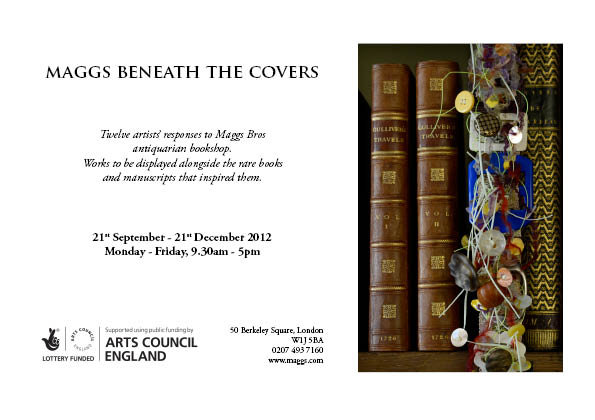
The Private View for 'Maggs Beneath the Covers' held at Maggs Antiquarian Bookshop 50 Berkeley Square, Mayfair to coincide with the Lapada Art and Antiques Fair was definitely an upper crust affair - even down to the hand-raised, traditional crusty meat pies with lashings of English mustard served alongside the champagne.  There was cake too - quite a spread.  These days it's rare to see so much as a peanut at the average private view.  Curator Penny Green had done us proud and not just with the finger food.


Works by the twelve artists who'd been commissioned to respond in 'extreme and conceptual ways' to Maggs' collections of rare books and manuscripts are beautifully displayed over all four floors of the Georgian town house close to the books that inspired them.  Some are in hallways and others in the garden - including 'books of remembrance' by ceramist Robert Cooper .

 
Penny Green's own work installed on the first floor landing - two seated figures representing the poets Elizabeth Barrett and Robert Browning - looks as if it had been there forever.  Look carefully and you can just spot Robert Browning sitting in the sunlight by an orange tree.
 
In curating the exhibition Penny had decided not to have any labels or statements close to any of the work.  A small brochure guides visitors to the general location of each piece and they are left to discover them, or not! depending on their powers of observation.  Some of the interventions are so subtle as to be easily missed.  But that's the fun of this kind of exhibition - it invites curiosity, exploration and active engagement with the site. 


Some of those who came got so into the spirit of discovery that they were found wandering 'off piste' in the dusky underground storerooms and passage-ways trying to decide whether the various piles and accumulations were art-works or just dead stock.  Brave of them I thought, as darkness was falling and the place is notoriously haunted by a broken-hearted 'Mr Havisham' - cruelly jilted on his wedding day.
 
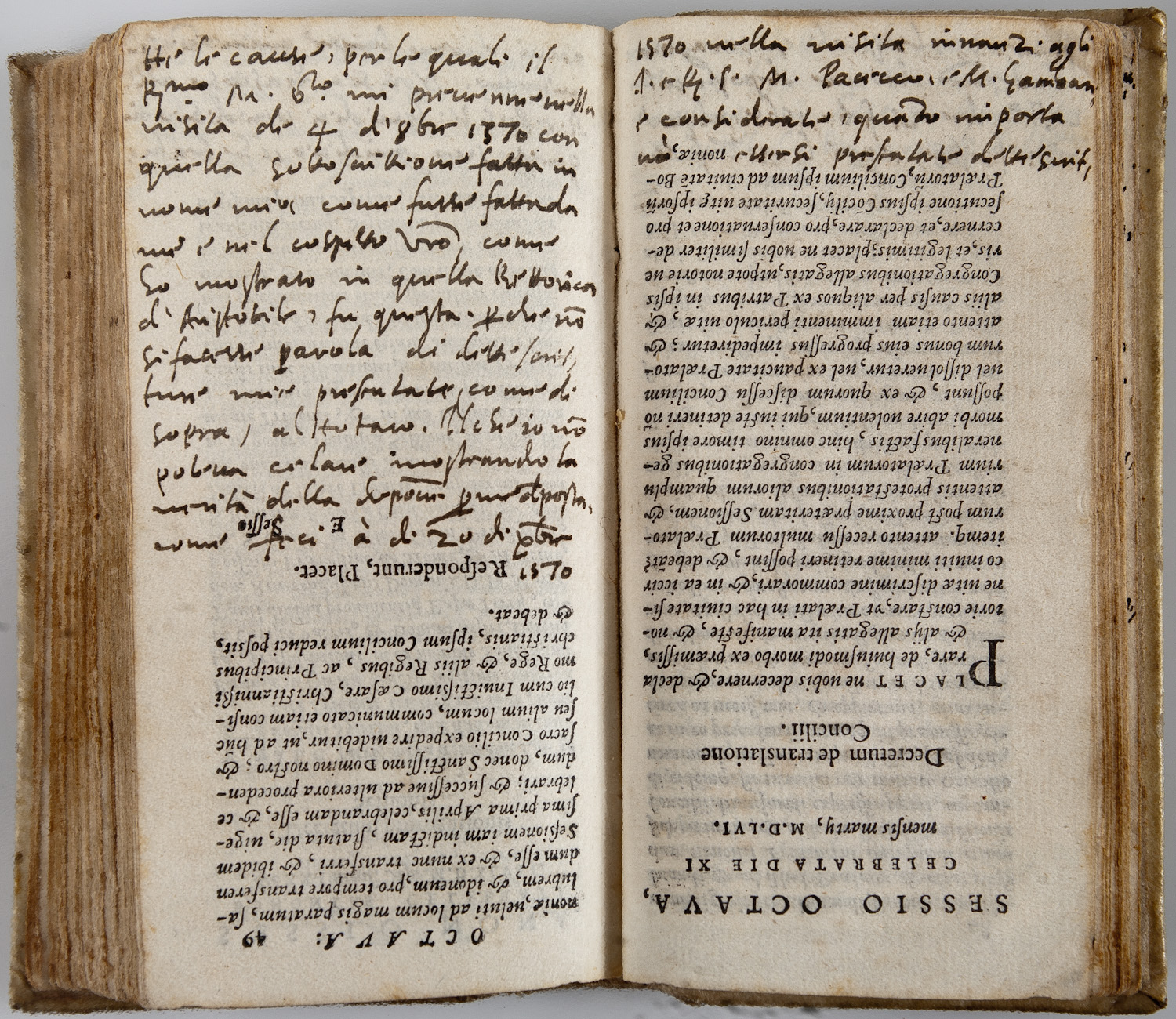
My piece 'Between the  Lines' is sited on the second floor in the Continental and Illuminations Department close to where I'd been standing when I'd first glimpsed 'my' book in Paul Quarrie's hand on the site visit.  I was expecting a special visitor to the private view, Cat Lucas, English Pen's Writers at Risk campaigns manager, and had arranged to meet her there.  Cat had asked me to write a guest post for their website and in yet another example of happenstance the posting and the exhibition opening  co-incided with the release of Salman Rushdie's latest book 'Joseph Anton'.  Censorship, free speech and freedom of artistic expression were hot topics.  
 
 
Between the Lines by Stella Harding
 
Although ultimately the work will have to speak for itself and tell its own story, being there in the room alongside it gave me an opportunity to find out what it has to say to others and to answer questions about it.  A member of Magg's staff had seen the piece prior to the private view, and, knowing little about it, told me it reminded her of a brazier - in which banned books might have been burned. In the sixteenth century when Francesco Ghesi, the book's owner, was writing his defence to charges of heresy it was more than books that were being burned - convicted heretics could face death at the stake.  In recent years we've seen the burning of books and effigies of writers by religious fundamentalists and only a few weeks ago on July 30th, Dang Thi Kim Lieng, the mother of imprisoned Vietnamese blogger Tai Phong Tan, died in a defiant act of self immolation.  She was protesting the detention of her daughter - a former policewoman who'd built up followers around the world with her blogs about police abuses in Vietnam.
 
 
Most people wanted to see the book that had inspired my piece.  Impossible in this case as it had been sold before I'd had the chance to really see it myself.  But imagination is a wondrous thing and as I explained that the small area of 24 carat gold leaf represents the 'footprint' of the book - people began to make connections with other imprints, shadows and memories of lost objects from their own experience.
 
 
When Cat Lucas arrived we were able to connect the small size of the book to the size of Francesco Ghesi's handwriting as he'd written in the spaces between the printed text.  Many prisoners of conscience write under extreme conditions - some write in infinitesimally small script on tiny scraps of paper or rag which can be smuggled out by friends or sympathetic guards.  Handwriting can say so much about a person too and small changes over time often alert human rights observers monitoring a prisoner to changes in their circumstances.
 
I'd enjoyed handwriting a letter to Busra Ersanli, something I haven't done for years, and had been touched to receive her letter in return - hand written after her release pending retrial.  In a sense this project has been as much about the history of human communication as about one book.  The laborious work of stamping individual letters onto the lead strips was juxtaposed by the immediacy of tweeting an update to this blog - telescoping the centuries from Roman times to 21st century social media.  My internet searches, emails to English Pen, blog posts and various digital interconnections are as much a part of the creative process of this project as the final woven lead container.  What connects us as humans isn't the means by which we communicate but the desire to do so.  The desire for freedom of speech and artistic expression will find a way.
 
 
I'm writing this post now as Busra Ersanli and nearly two hundred others face another  trial in Turkey tomorrow October 1st.  In her letter to me Busra wrote of her friend, the translator and women's rights activist Ayse Berktay and whether anything could be done to bring her to attention.  Ayse's name is one of several imprinted on the lead - a small gesture of solidarity.
 
Monday October 1st also sees the hearing in Russia of an appeal by the three members of Pussy Riot, Nadezhada Tolokononikova, Maria Alyokhina and Ekaterina Samutsevich, imprisoned for two years after their peaceful performance protest against Vladimir Putin and leaders of the Orthodox Church who support his repressive measures.  Artist David Shrigley has added his support by designing a T-shirt for Amnesty International and English Pen are holding a Poems for Pussy Riot poetry protest at 11.00am on Monday October 1st at the Champion pub Wellington Terrace, London W2 4LW.  www.englishpen.org/poems-for-pussy-riot-ebook They are asking those who can't attend to write about the event and the ebook of poems on their websites, blogs and Twitter.   


Even the smallest gesture can make a difference to a prisoner of conscience. Sending a book, a letter or postcard of solidarity lets them and their captors know that they are not lost to the eyes of the world. A quick tweet or an email to a government or regime acting in contravention of human rights costs nothing, takes only a few moments and is surprisingly simple to do with modern communications technology.  See English Pen's Rapid Action Network for how to do it. www.englishpen.org
 
If you get the chance please do visit 'Maggs Beneath the Covers'.  Don't be put off by the imposing location and the entry buzzer.  You'll find a warm welcome inside 50 Berkeley Square and the freedom to explore and discover for yourself all the inspiration you could desire.
 
'Maggs Beneath the Covers' is on until 21st December 2012.  9.30- 5.00pm Monday-Friday, closed Saturday and Sunday. Please see www.maggs.com for more information.


Sunday, 16 September 2012

END OF THE LINE: Maggs Beneath the Covers #6 the weave


It's only a few days before the exhibition 'Maggs Beneath the Covers' opens - 12 artists responding in extreme and conceptual ways to Maggs collections of rare books and manuscripts.  I haven't seen my finished piece since it was delivered to Maggs over two months ago and now feel as if I'm writing backwards - reflecting on and un-weaving the making process. 

When I delivered my piece I got chatting to another maker who was testing the installation of her work.  I asked how she'd come across the book that inspired her.  I was fascinated to hear she'd gone exploring Maggs on-line catalogue for an appropriate volume!  She'd conceived of what she wanted to make, determined by the nature of her practise and her current interests, and had then gone looking for a book that would fit the concept.  Retro engineering! Well, why not?  Why trust to happenstance and chocolate rabbits as I had done?  My more process-led approach was to work with whatever called out to me and to follow its desire line - wherever that might lead.  This might have some relation to the way basket makers often make use of whatever seasonal materials they happen to come across in their locale.

Exactly why a book owned by an imprisoned writer (my raw material) should have struck a chord with me at this juncture is something I'll reflect on later.  Perhaps it had something to do with having recently had a book published myself for which I'd written the, albeit uncontroversial, text.  Suddenly I was not simply a co-author who'd worked on the overall construction of a book but the writer who'd selected, manipulated and crafted the words, sentences and paragraphs.  This subtle distinction was an important one for me, my creative labour not to be appropriated through elision.

 
Stella Harding GREEN JEWEL 2010 Photo: Sylvain Deleu
 
A item of basketry, as with any crafted object, is a fusion of four variables: material, technique, form and function, each of which interacts with a more nebulous fifth - location or context.  I more typically make abstract, sculptural forms, exploring combinations of materials, techniques and forms to create re-natured assemblages that function as objects for the contemplation of the ontological uncertainty of human/nature. 


                               Stella Harding KEPLER'S JEWEL 2011 Photo Trevor Springett


Plaited vintage printed steel tape measure bangle
 
At other times they might be worn as a measure of certainty, but they rarely look like conventional baskets. 

For the Maggs piece  I'd allowed my researches into the unfolding storyline to dictate which material I'd use - lead, the imprinted lead then to dictate an appropriate technique - an open weave that would distribute the leaden weight economically, and the combination of material/technique to dictate the form - which I was beginning to realise was going to have to be ... a fairly conventional looking basket! 

I recalled the first site visit when Robert Harding (no relation), one of Magg's directors, had spoken of the book as the 'perfect object'.  In other words, from the time the first bound volume was made the book hasn't changed its form or the way we interact with it.  Even an e-book mimics the way we open and hold a book and turn its pages.  Baskets come in many forms depending on their function but archaeological finds tell us that the basic forms for specific  functions haven't changed in millenia.  So, just as the unremarkable appearance of Ghesi's small book belied its extraordinary story, I would reflect this by making a fairly unremarkable basketry form - to function as a kind of 'stealth craft' - an innocent looking decorative container which would belie its content.  Not as a container for an imprisoned writer - as I'd originally proposed, but as an expression of the transformative power of books to free the imagination.


And so at last the weave began, with a six-pointed star - or a hexagon surrounded by six triangles, depending on how you look at it.  These are the  first set of connections in open hexagonal plaiting - a multi-directional (3-way) weave more commonly used for making lightweight, ephemeral containers for transporting small livestock to market. With a bit of practice it's a quick, economical weave that's used a lot in the Far East with indigenous plant material such as bamboo or rattan which can easily be split or cut into flat strips.
 
                                                              
It's also one of my favourite weaves and gave me a personal connection to the story.  I've used it a lot with strips of paper or plastic tape, chair cane and cardboard.  Lead though is not a typically 'appropriate' material to use with this technique.  It has too much 'memory' and little energy or will of its own.  It's extreme malleability verges on passive resistance! But I enjoyed these qualities - it forced me to think about every move I made with this delicate and yielding material whose subtle beauty belies its reputation as a base, toxic metal.  And the  starry weave is fitting for a different reason; for lead, like all the heavy metals, was  forged in the white heat of an exploding super nova billions of years ago. What came from the stars was woven into stars.


Even before I'd begun weaving the base I knew I'd be unable to add extra horizontal elements to form the sides.  I didn't want any lumpen overlapping joins so I used a bias weave even though it disrupted the pattern of stars and hexagons.
 
 
In fact the sides were a combination of a bias lattice plait with hexagonal 'intervals'.  The weave was  uneven at first despite my best efforts, but a few hours spent with a lump hammer coaxing it into shape over a mould sorted that out. 
 
Throughout the making I'd been pondering how to represent the book itself.  One idea had been to make a porcelain slab the same dimensions as the book and to decorate it with gold lustre thus recreating my 'lost object' in tangible form. In the end there were frustrating technical issues to do with lustre-firing that couldn't be resolved in the time remaining.  My compromise solution was to gold leaf a section of the weave  the size of the book. 


What seemed like an expedient compromise turned out for the best. Now, this alchemical symbol of Francesco Ghesi's book has become one with the weave - highlighting the parallels  with Busra Ersanli as his word 'justice' intersects with her word 'solidarity'.  That gold foil covered chocolate bunny has a lot to answer for!


                Viewed from certain angles the golden rectangle sheds precious light in a dark place and illuminates the text as in a medieval manuscript. 

 
Whilst from another perspective the ecclesiastical overtones of the interior spaces are undeniable.
 
My final decisions were about how to finish off the basket -  how to end the story. I'd dispensed with issues of joining by choosing a bias plaiting technique that didn't require extra elements.


There was something compelling about not resorting to a neat resolution.  Looking askance from a different perspective showed there was no tidy closure to this story.  Though she was freed from prison after the first hearing Professor Ersanli and her co-defendants face another trial on the first of October.  Just the other day I received a reply to the letter I'd sent whilst she was in prison.  I was touched that she'd taken the time to write back to me and moved to tears by her bravery, dignity and selfless concern for her cell-mate, the translator and women's rights activist, Ayse Berktay.   Many loose ends, many more human connections, one strand at a time.
 
 
The end of the line has yet to be woven ...